Farm Animals Trace and Color: A Practical Tool for Early Learning and Creative Development
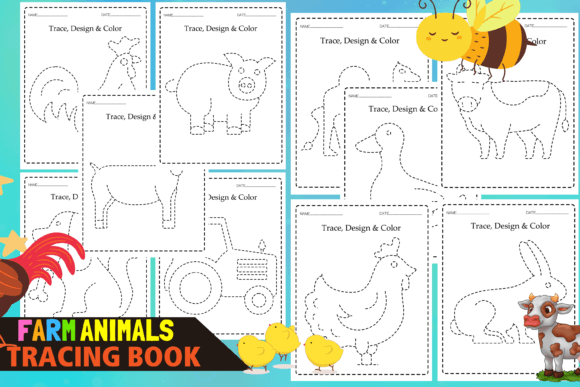
The Farm Animals Trace and Color activity book is a versatile resource designed to support early childhood education through engaging, hands-on learning. This digital download offers a collection of high-quality tracing and coloring pages featuring familiar farm animals, making it an ideal tool for educators, parents, and caregivers looking to enhance young learners' motor skills, creativity, and cognitive development.
As part of a broader educational process, the Farm Animals Trace and Color book fits seamlessly into various learning environments, including classroom settings, homeschooling routines, and at-home activities. Its structured design supports both independent and guided learning, allowing children to practice fine motor skills while exploring the world of farm animals in a fun and interactive way.
Understanding the Role of Farm Animals Trace and Color in Learning Workflows
For educators and parents, integrating Farm Animals Trace and Color into daily routines can be a strategic move that aligns with specific developmental goals. Whether used as a morning work activity, a fast finisher task, or a supplement to distance learning, the book provides a consistent and reliable resource for reinforcing key concepts such as letter formation, number recognition, and shape identification.
The book’s 15-page layout, featuring high-resolution images and thick black lines, ensures that each page is easy to print and customize. This makes it particularly useful for teachers who need to prepare materials quickly or for parents who want to create personalized learning experiences for their children. The ability to resize and print at any size also adds flexibility, allowing users to adapt the content to different learning needs and preferences.
When planning lessons or setting up learning stations, the Farm Animals Trace and Color book serves as a valuable asset. It can be incorporated into a larger curriculum focused on animal habitats, nature studies, or thematic units, providing a hands-on component that complements other instructional materials. Its focus on tracing and coloring also supports the development of hand-eye coordination and pencil control—skills that are essential for future writing tasks.
Integration with Other Educational Tools and Methods
The Farm Animals Trace and Color book works well alongside other educational resources, such as cursive writing notebooks, phonics worksheets, and interactive storybooks. By combining these tools, educators and parents can create a more comprehensive learning experience that addresses multiple developmental areas simultaneously.
For example, a teacher might use the book as part of a unit on farm animals, pairing it with science lessons about animal life cycles or social studies activities about rural communities. Similarly, a parent could use the book to reinforce letter sounds during reading time, encouraging their child to trace and color letters associated with each animal name.
The book’s versatility also allows it to be used in conjunction with technology-based learning tools. Digital platforms that offer interactive tracing or coloring activities can be paired with physical worksheets from the Farm Animals Trace and Color book, creating a blended learning approach that caters to different learning styles and preferences.
Practical Implementation Tips for Educators and Parents
To maximize the effectiveness of Farm Animals Trace and Color, consider the following implementation strategies:
- Set clear objectives: Determine what skills you want to target, such as letter formation, shape recognition, or color identification, and select pages that align with those goals.
- Use it as a warm-up activity: Incorporate the book into daily routines as a starting point for other learning tasks, helping children transition into focused learning mode.
- Encourage creativity: Allow children to choose their own colors and add personal touches to their drawings, fostering a sense of ownership and engagement.
- Track progress: Keep a record of completed pages to monitor improvements in handwriting, attention span, and confidence.
For educators, the Farm Animals Trace and Color book can be used as part of a differentiated instruction strategy, offering varying levels of difficulty to accommodate diverse learner needs. Teachers can also use the book to provide additional practice for students who require extra support or to challenge those who are ready for more advanced tasks.
Parents can benefit from the book’s convenience and accessibility, especially when managing busy schedules or supporting remote learning. The digital format means that pages can be printed as needed, eliminating the need for physical storage or frequent reordering of supplies.
Long-Term Use and Value
One of the key advantages of Farm Animals Trace and Color is its long-term usability. The high-quality PDF files ensure that the pages remain clear and legible even after multiple uses, making the book a cost-effective investment for families and educators alike.
Additionally, the book’s focus on fundamental skills means that it can be used across multiple grade levels and age groups. While it is particularly well-suited for preschoolers and early elementary students, older children who need extra practice with handwriting or creative expression can also benefit from its structured approach.
By incorporating Farm Animals Trace and Color into regular learning routines, users can build consistency and reinforce positive habits. The book’s engaging content helps maintain children’s interest over time, ensuring that they continue to look forward to each new page.
Conclusion
The Farm Animals Trace and Color activity book is more than just a set of tracing and coloring pages—it is a practical, adaptable tool that supports early learning and creative development. Its ease of use, high-quality design, and alignment with educational goals make it a valuable addition to any learning environment.
Whether used in the classroom, at home, or as part of a distance learning program, the book offers a straightforward and effective way to engage young learners. By integrating it into daily routines and pairing it with other educational resources, educators and parents can help children build essential skills while fostering a love of learning.